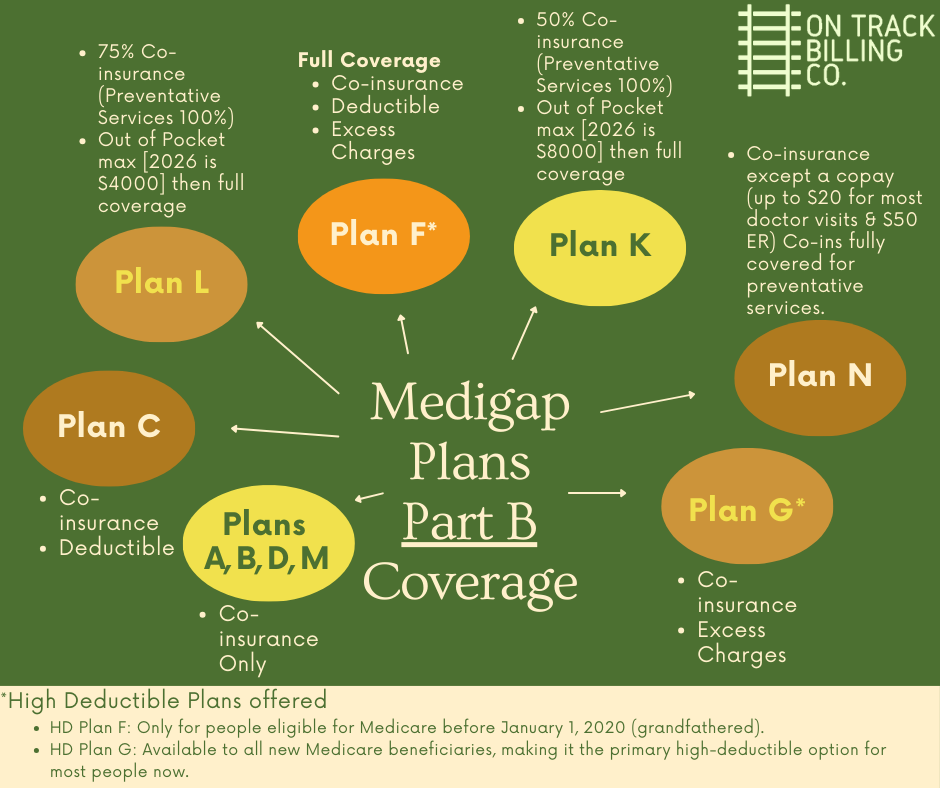
How Medigap Plans Work
For Front-End, Billing, and Revenue Cycle Management Staff
What Is a Medigap Plan?
A Medigap plan (also called a Medicare Supplement) is a private insurance policy that helps pay for the “gaps” in Original Medicare (Part A + Part B) coverage.
Medigap does NOT replace Medicare.
It supplements it by covering patient cost-sharing such as:
Part A deductible
Part B coinsurance
Part A hospital coinsurance
Skilled nursing facility coinsurance
Hospice coinsurance
Foreign travel emergency care (in some plans)
Important: Medigap plans cannot be used with Medicare Advantage (Part C).
What Medigap Plans Do (and Don’t) Cover
✔ What Medigap Covers
Depending on the plan (A–N), it may cover:
Part A coinsurance & hospital costs (all plans cover this)
Part B coinsurance/copayments
Blood (first 3 pints)
Part A hospice coinsurance/copay
Skilled nursing facility coinsurance
Part A deductibles
Part B excess charges (only in Plans F & G)
Foreign travel emergency care (some plans)
✘ What Medigap Does Not Cover
Medigap does not cover:
Prescription drugs (Part D)
Vision, dental, or hearing benefits
Long-term care
Anything not covered by Medicare Part A or B
Medicare Advantage cost-sharing
How Medigap Works in the Billing Process
Step 1: Medicare processes the claim first
Medicare Part A or B is always the primary payer.
They:
Review the claim
Apply Medicare’s allowed amount
Pay their portion to the provider
Send an Explanation of Benefits (EOB)
Automatically forward the claim to the Medigap plan (called crossover)
Step 2: The Medigap plan pays secondary
After Medicare pays, the Medigap carrier processes the remaining balance according to the specific plan coverage.
Step 3: Patient responsibility (if any) is billed
If the Medigap plan does not fully cover the remaining coinsurance/deductible, the patient may owe:
Part B deductible (unless they have Plan C or F)
Non-covered services
Excess charges (if not covered by their plan)
4. Understanding the Different Medigap Plans (A–N)
Most Common Plans Today:
Plan G
Covers everything except the Part B deductible
Most popular since Plan F closed to new enrollees
Plan N
Covers most items except Part B deductible & excess charges
Patient may owe small office visit or ER copays
Plan F
Covers all Medicare cost-sharing, including Part B deductible
Only available to individuals eligible for Medicare before Jan 1, 2020
Key Concepts Staff Must Understand
1. Medigap vs. Medicare Advantage
Medigap = supplement to Original Medicare
Medicare Advantage = replaces Original Medicare
Patients cannot have both.
If you and/or the patient is unsure of which, you can check what Medicare eligibility shows on NGSConnex.
2. Automatic Crossover
Most Medigap plans automatically receive the claim from Medicare.
If not, the provider may need to submit, it is common for the medigap card to say if claims are crossed over directly from Medicare or not.
3. No Networks
Medigap has no provider networks.
If a provider accepts Medicare, they accept:
The Medicare rate
Any Medigap plan
4. No Prior Authorizations
Medigap plans do not require referrals or prior authorizations.
If Medicare approves the service, Medigap pays its portion.
5. Medigap Pays Only After Medicare Approved Services
If Medicare denies a service:
The Medigap plan will also deny
Patient can only be billed if an ABN was signed
What Front-End Staff Should Verify
At registration or check-in, confirm:
Patient has Original Medicare, not Medicare Advantage
Medigap plan carrier (AARP/UHC, Highmark, Mutual of Omaha, etc.)
Plan letter (if the card lists it)
Policy number
Whether Part B deductible applies
If the patient recently changed plans (common during open enrollment)
Ask the patient:
“Do you have a Medicare Supplement, Medicare Advantage, or both Medicare and a secondary insurance?”
It is common for patients to mistakenly say “Medicare” when they mean Medicare Advantage. If they are not sure and just hand over all of their insurance cards, coverage can be verified on NGS Connex. If they do not have their cards, a social security number is required to get their information from Medicare.
What Billing & RCM Teams Must Understand
Billing Tips
Ensure Medicare is billed as primary
Check that the Medigap payer ID is correctly set for crossover
If crossover fails, submit to the Medigap plan directly
Always carefully and thoroughly review Medicare and Medigap EOBs before billing the patient
Common Errors
Billing Medigap as primary
Treating a Medicare Advantage plan like a Medigap
Sending claims to the wrong payer ID
Assuming Medigap covers non-Medicare services (it doesn’t)
How to Explain Medigap to Patients (Staff Script)
Simple explanation:
“Your Medicare Supplement helps pay the portion of your bill that Medicare doesn’t cover, like deductibles or coinsurance. Medicare pays first, then your supplement pays according to your specific plan.”
If Medicare denies a service:
“Your supplement can only pay after Medicare pays. Since Medicare did not approve this service, your supplement also cannot pay it.”
If crossover didn’t occur:
“Medicare didn’t forward the claim to your supplement, but we will submit it for you.”